Collect
Organise previous-year questions and relevant learning material with clear provenance.
AI-powered teaching, assessment and learning intelligence—connecting educators and learners through insight that leads to action.
documented education-AI capabilities
20 for institutions + 20 for learners
product audiences
Students and education organisations
learning intelligence approach
Assessment → insight → next action
Most preparation systems stop after marking a question right or wrong. AbhyasDhara Intelligence Lab connects practice, possible misconceptions and what to do next.
A learner gets the answer wrong when the base quantity changes. The pattern suggests revisiting percentage change, not repeating an entire chapter.
Two guided examples → a five-question check → a later retrieval session.
Educator/learner remains in controlTwo distinct products, one shared approach to better teaching and preparation.
AI tutor, doubt solving, adaptive mock tests, revision and personalised plans—connected to how a learner actually performs.
Explore the student experienceLive-class question intelligence, teacher-reviewed paper drafts, batch analytics and institution tooling, designed for scale.
Explore the institution platformFounder-reported backing from an offline educator
Team-estimated completion of planned app work
Maximum programme size reported by team
A test tells you what someone answered. A carefully designed learning system should help explain which concepts need attention and what to do next.
The most important information in a test is not always the score. Sometimes, it's the pattern of thinking behind it.
We are researching an evidence-led workflow that connects previous-year papers, assessment design, learner performance and teacher judgement—with humans still responsible for important decisions.
A learning intelligence workflow. Every important AI-generated test or explanation is designed to be checked against sources and educator review.
Organise previous-year questions and relevant learning material with clear provenance.
Study topic frequency, question types and recurring conceptual patterns.
Draft question sets, explanations and practice suggestions around the evidence.
Keep educator checks and student feedback inside the improvement loop.
Research direction, not a claim that every workflow is already available in the Android app.
Explore a future teaching copilot for previous-year paper patterns, reviewable question-set drafts and finding genuine doubts in fast-moving live comments.
The educator vision ↗Researching a way to map weak concepts, suggest focused practice, and shape revision schedules around what a learner actually needs.
These are the capabilities being explored for AbhyasDhara Intelligence Lab AI—not a list of features already released to the public.
Find recurring topics and question styles in historical papers, while preserving links to source material.
Propose practice sets and explanation drafts that teachers can verify, edit and approve.
Distinguish genuine student questions from repetitive or irrelevant live-lecture comments.
Use answers, error patterns and effort signals to find where a learner may need reinforcement.
Recommend targeted tests, a practical study schedule and revision tips based on observed needs.
A target milestone aligned with India's Republic Day. Model development, validation and release scope remain ongoing; the date is a plan, not a guarantee.
The Android app is on Google Play. The team describes its testing programme as limited to a maximum of 10,000 participants; eligibility and current availability must be confirmed on Google Play.
Purpose-built, illustrative interface studies. Select a workflow to explore inputs, reasoning, sample results and human safeguards.
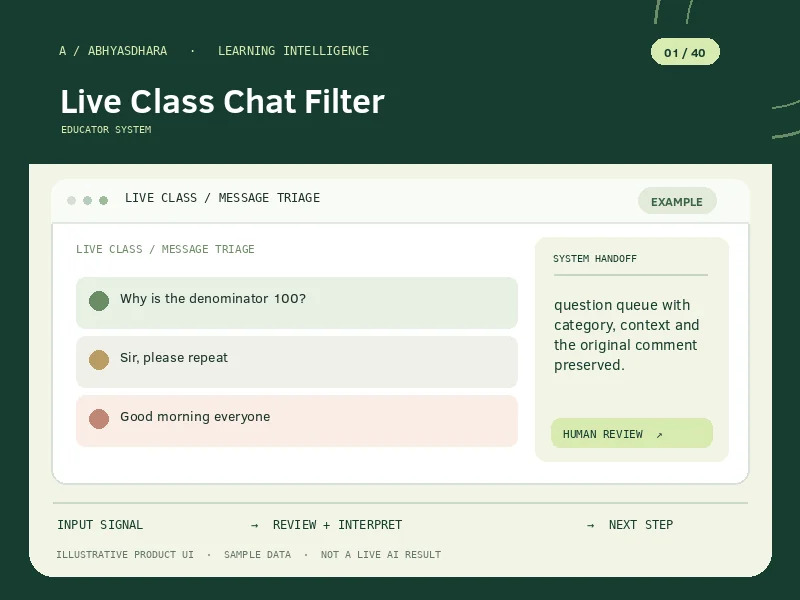
Separates academic questions from casual messages, likely spam and ambiguous replies. Keeps teachers in control of moderation.
View the detailed workflow ↗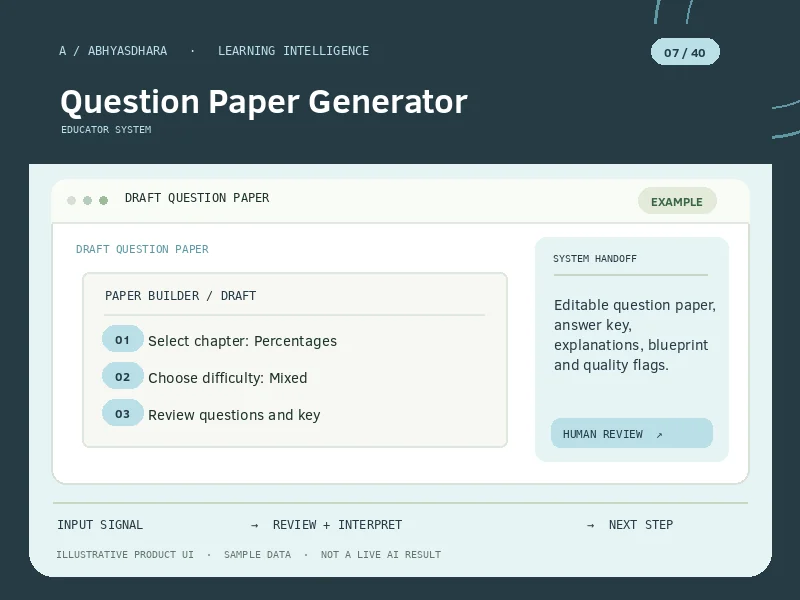
Builds paper drafts aligned to syllabus, topic, language, marks and difficulty, with an answer key.
View the detailed workflow ↗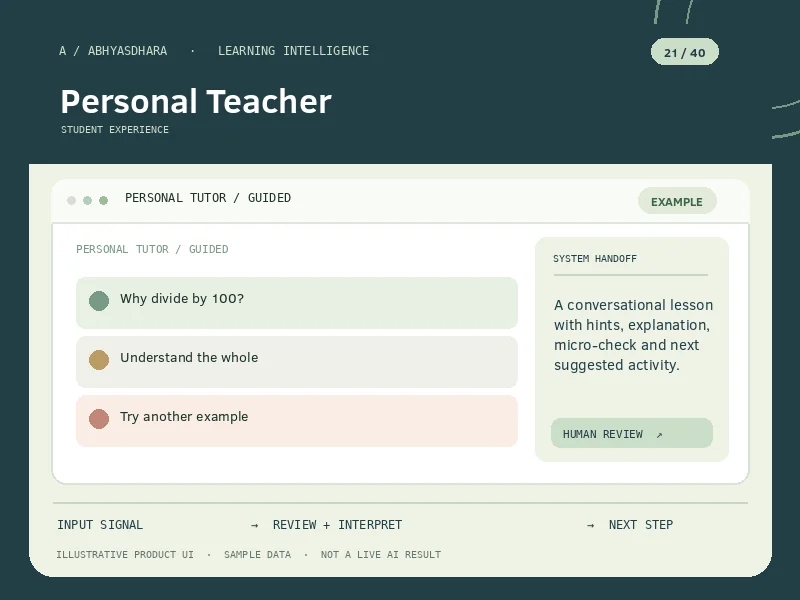
Explains a concept at the learner’s level, checks understanding and follows up.
View the detailed workflow ↗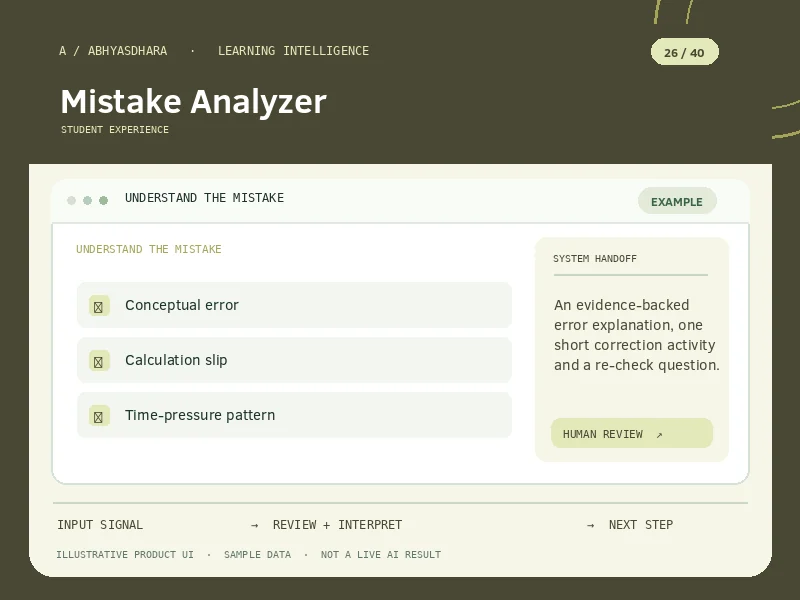
Distinguishes likely conceptual, calculation, reading and time-pressure errors.
View the detailed workflow ↗Are you an educator, coaching institute, or EdTech team? Start a conversation about the right learning workflow.