Previous-year paper pattern analysis
Study recurring topics, question formats and shifts across historical papers, with clear source provenance and caution about predictive claims.
Tools we are exploring to help teachers spend more time teaching and less time sorting, searching and repeating.
Teachers already bring judgement, context and experience. The idea behind AbhyasDhara Intelligence Lab AI is to make that work easier by interpreting the evidence around preparation—not issuing unreviewed answers as authority.
Study recurring topics, question formats and shifts across historical papers, with clear source provenance and caution about predictive claims.
Build draft tests from educator-defined subjects, difficulty mix and learning objectives. Include explanation drafts that teachers can inspect and refine.
Investigate how real student questions can be identified among repetitive messages, unrelated discussion and fast-moving live chat.
Group recurring uncertainties into revision topics or follow-up explanations, without exposing individual learner information unnecessarily.
Team-provided product scope: The educator features are described as implemented by the team. Public live-stream integrations, institute onboarding and model accuracy have not been independently verified. The examples on this website are not connected to production services.
Generated questions or explanations may be incorrect or misaligned with the exam. Our intended design gives educators an approval and editing step before learners receive material.
Live comment analysis and learner diagnostics require data minimisation, safeguards and clear controls. These are design obligations, not optional extras.
Instead of asking teachers to adapt to a black box, our research direction is to make the AI adapt to the educator’s context.
See how the research works ↗From paper creation through classroom analytics, explore each practical workflow.
Purpose-built, illustrative interface studies. Select a workflow to explore inputs, reasoning, sample results and human safeguards.
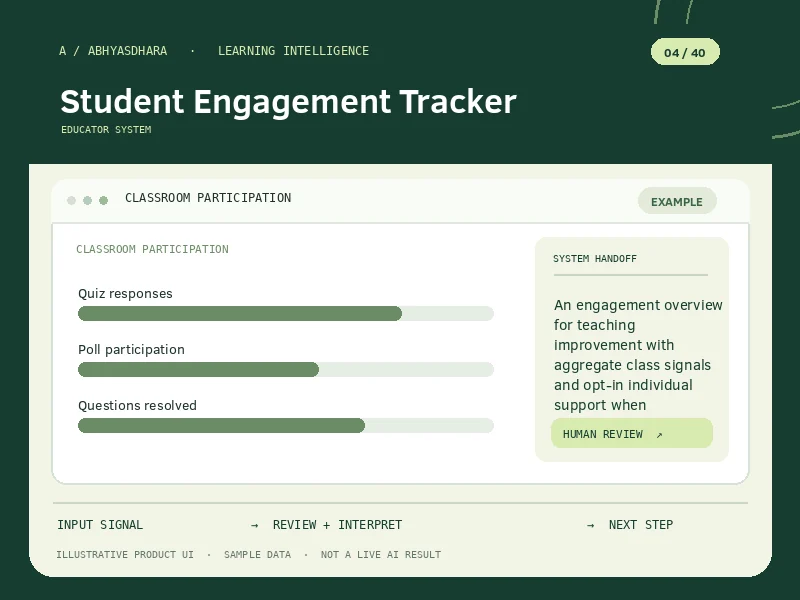
Uses quiz participation, polls and activity rather than invasive camera surveillance.
View the detailed workflow ↗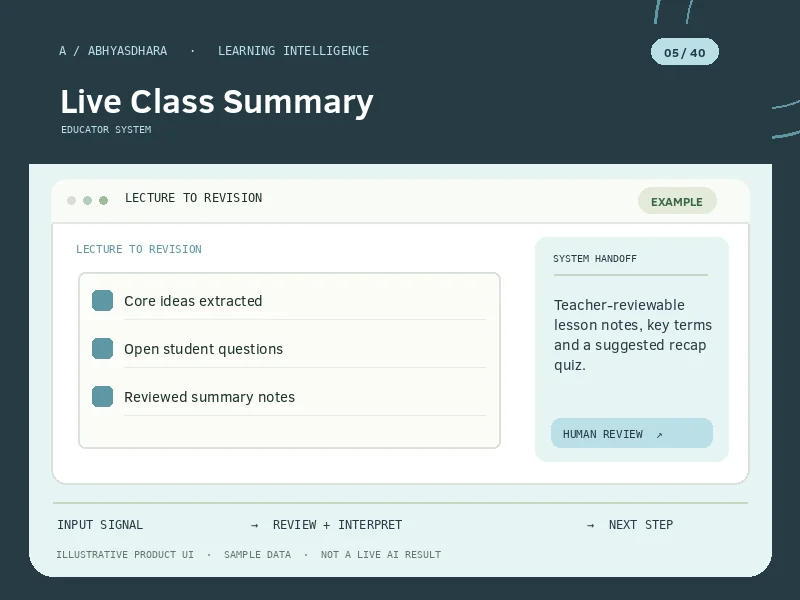
Turns approved transcripts into structured lesson summaries, key questions and follow-up material.
View the detailed workflow ↗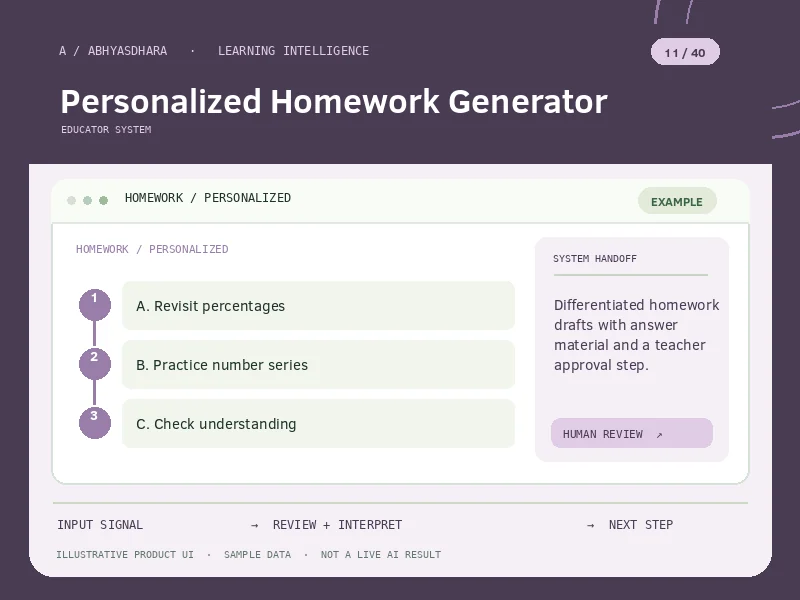
Creates differentiated practice sets based on demonstrated gaps, not one-size-fits-all homework.
View the detailed workflow ↗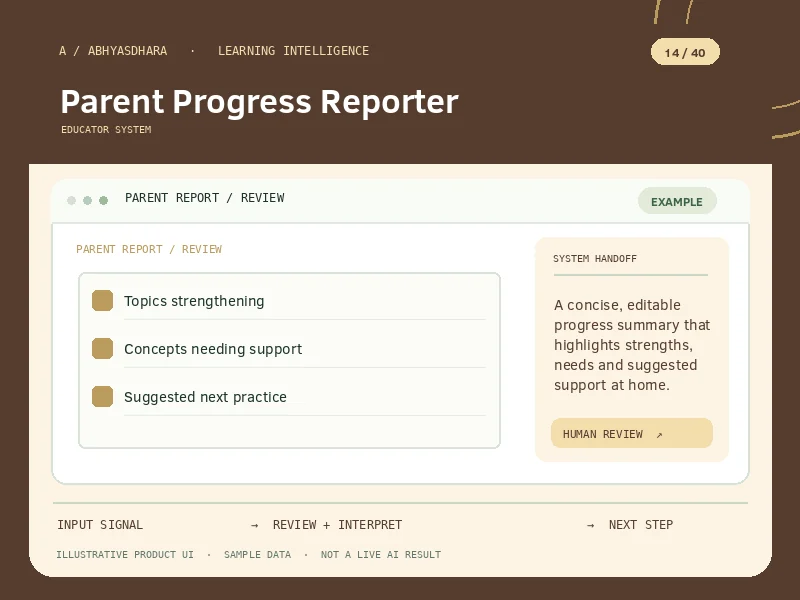
Drafts plain-language progress updates for teachers to approve before sharing.
View the detailed workflow ↗