Start with the learning question
A low total score hides which specific steps repeatedly cause difficulty and can lead to unnecessary whole-chapter revision.
A low total score hides which specific steps repeatedly cause difficulty and can lead to unnecessary whole-chapter revision.
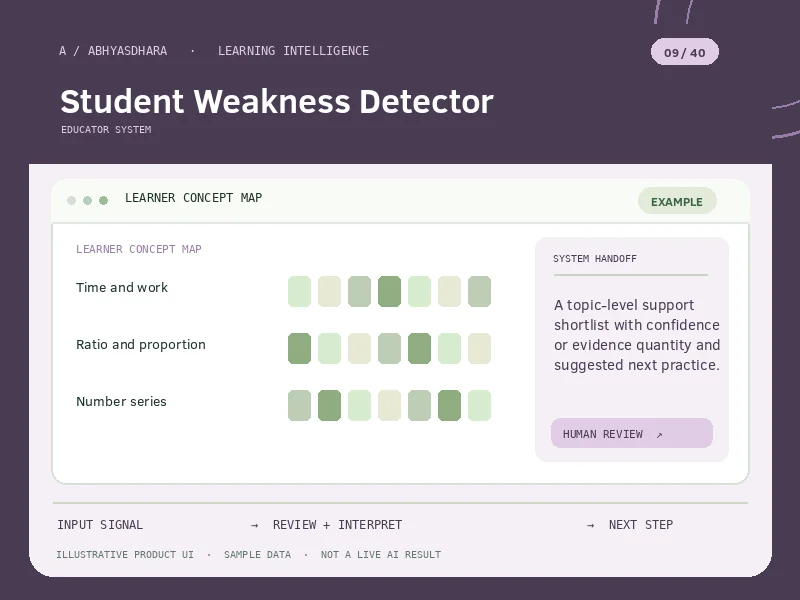
Finds struggling concepts across attempts and recommends timely academic support.
Separate likely concept gaps from careless reading and insufficient evidence; connect each provisional finding to supporting questions.
Explore all 40 feature visuals →A low total score hides which specific steps repeatedly cause difficulty and can lead to unnecessary whole-chapter revision.
Separate likely concept gaps from careless reading and insufficient evidence; connect each provisional finding to supporting questions.
A topic-level support shortlist with confidence or evidence quantity and suggested next practice.
Review the sequence from input to reviewable output.
A low total score hides which specific steps repeatedly cause difficulty and can lead to unnecessary whole-chapter revision.
Question-level outcomes, topic tags, attempts over time, response patterns and data sufficiency indicators.
Separate likely concept gaps from careless reading and insufficient evidence; connect each provisional finding to supporting questions.
A topic-level support shortlist with confidence or evidence quantity and suggested next practice.
Example only. This is not live customer data or an AI-generated result.
A learner misses three percent-change questions with the same denominator mistake while succeeding on basic percentages.
A weakness estimate is temporary, not a permanent ability label. Sparse data should be shown as insufficient evidence.
A weakness estimate is temporary, not a permanent ability label. Sparse data should be shown as insufficient evidence.
Illustrations are not live AI output or evidence of tested accuracy.